How HR teams can use video tutorials for training
83% of employees prefer watching videos over text or audio when consuming instructional content — yet most organizations are still relying on dense PDFs, slide decks, and hour-long sessions that employees tune out before they've finished.
HR teams are under more pressure than ever: onboarding new hires, rolling out compliance programs, upskilling existing staff, and keeping remote employees engaged — all with limited time and resources. Traditional training methods weren't built for this scale, and the engagement gap shows.
Video tutorials have moved from a nice-to-have to a core pillar of effective workforce training. WowTo makes it simple for HR teams to create, manage, and share professional-quality video tutorials without needing a production team or technical expertise. This guide covers where video adds the most value in HR training — and how to build a program that actually works.
What do video tutorials mean for HR training
Video tutorials are step-by-step instructional videos that walk learners through a process, concept, or skill. In an HR context, they can cover everything from completing a benefits enrollment form to explaining the performance review cycle. Unlike static PDFs or hour-long live sessions, video tutorials are self-paced, replayable, and available on demand.
For HR teams trying to ensure compliance, embed company culture, and build consistent skills across a distributed workforce, those numbers represent a significant operational advantage.
Not sure which video format fits which training goal? WowTo's breakdown of instructional videos vs. training videos is a useful reference before you start building your library.
Key areas where HR teams can use video tutorials
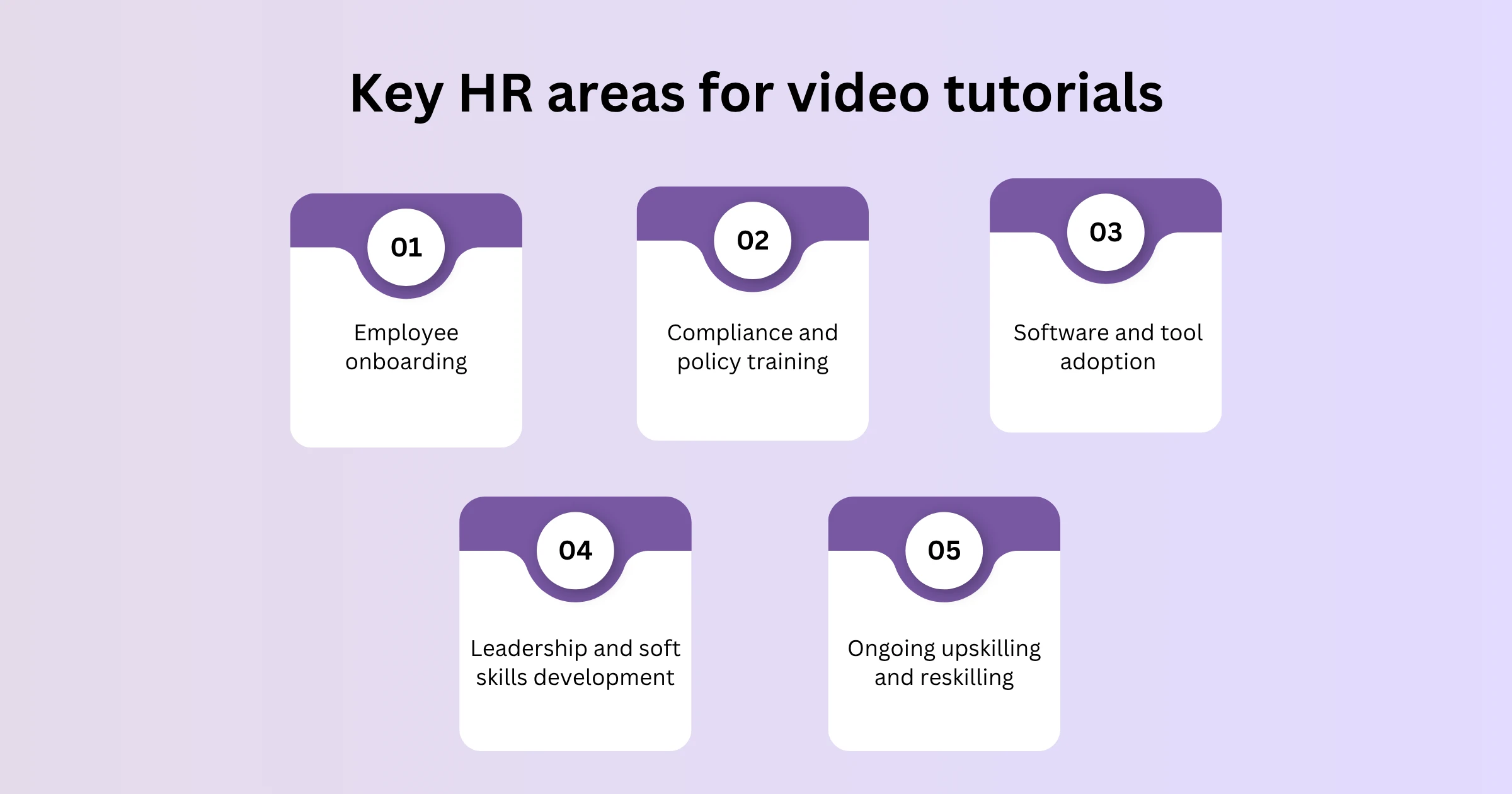
1. Employee onboarding
Onboarding is where first impressions are made — and where poor execution is most costly. Research shows that 1 in 3 new hires begins looking for another job soon after starting due to a poor onboarding experience. Yet building a consistent, engaging onboarding program is one of the hardest things for HR teams to maintain, especially in growing or hybrid organizations.
Video tutorials solve this by turning onboarding into a structured, self-serve experience. New employees can watch videos covering company values, team introductions, how to use internal tools, and HR processes — at their own pace, before or after Day 1. This also frees up HR staff from repeating the same sessions week after week.
Explore how automated video training can reduce employee onboarding time significantly while improving the quality of the experience for new hires.
2. Compliance and policy training
Compliance training is non-negotiable, but notoriously hard to make engaging. Research shows 49% of workers admit to skipping through mandatory compliance training purely for completion purposes — meaning the training achieves nothing. Video tutorials change this dynamic by presenting topics like harassment prevention, data privacy, and workplace safety through short, clearly narrated videos with real examples — making content easier to absorb and harder to skim.
Because videos can be updated quickly when policies change, HR teams no longer need to reprint materials or reschedule sessions.
3. Software and tool adoption
Every time a company rolls out a new HRIS, payroll platform, or collaboration tool, HR teams face the challenge of getting employees up to speed quickly. Screen-recorded video tutorials are the ideal format here — employees can watch exactly what to click, where to go, and what to expect, and rewatch at any point.
Before you start recording walkthroughs, it is worth reviewing the top screen recording mistakes to avoid so your software training videos land well from the start.
4. Leadership and soft skills development
Video is not just for process-based training. HR teams can also use it for leadership development, communication skills, and culture-building content. Short videos featuring senior leaders sharing values, lessons learned, or behavioral expectations carry far more weight than written memos — they humanize the message and make it more memorable.
For formal skills training, video tutorials can introduce concepts like giving feedback, running effective meetings, or managing conflict — which learners then practice in real situations. If you are thinking through the broader landscape of training approaches, WowTo's guide on how to choose the right employee training method for your team is a helpful companion read.
5. Ongoing upskilling and reskilling
HR teams are at the center of this challenge — but they cannot deliver ongoing training through traditional methods alone.
A library of video tutorials organized by role, function, or skill area gives employees a resource they can return to continuously. The same principles that make video training in customer education reduce time-to-value apply directly to internal employee development programs — shorter learning curves, faster skill application, and stronger retention.
Why video works better than text-based training
The case for video over text is rooted in how people process and retain information. Here is why video tutorials consistently outperform written training materials in an HR context:
- Clarity through demonstration — showing a process is faster and clearer than describing it. Video eliminates the ambiguity that written instructions often leave behind.
- Higher engagement — 68% of employees prefer video-based learning over text-based materials, meaning learners are more likely to complete the content and stay focused throughout.
- Consistent delivery — every employee sees the same training, regardless of when they join or where they are located. This is especially critical for compliance content.
- Self-paced flexibility — letting employees learn at their own pace can increase retention by 25 to 67%. Employees can pause, rewatch, and revisit on their own schedule.
- Scalability — There is no incremental cost per learner, making video training one of the most cost-efficient formats available.
How to build a video training program as an HR team
- Start with your highest-impact use cases. Do not try to build a full video library at once. Start where the pain is sharpest — training that takes the most HR time to deliver, generates the most repeated questions, or has the lowest completion rates. Onboarding and compliance are almost always the right starting points. WowTo's guide on top training and development techniques every company should know offers a useful framework for prioritizing.
- Keep videos short and focused. The most effective training videos cover one concept or process at a time, ideally under five minutes. This makes content easier to update, easier to navigate, and more likely to hold a learner's attention.
- Organize content so employees can find it. A training video that cannot be found is a training video that does not help anyone. Organize your video library by topic, role, or workflow — and make it searchable. A centralized video knowledge base ensures employees who need a refresher can find what they need in seconds.
- Update regularly. Policies change, tools get updated, and processes evolve. Build a habit of reviewing your most-used training videos quarterly and refreshing them when anything changes. WowTo's fast editing capabilities let you update individual clips without re-recording from scratch.
- Measure what matters. Track completion rates, watch times, and — where possible — the downstream impact on support ticket volume or performance outcomes. Video platforms typically provide built-in analytics that make this tracking straightforward.
How WowTo helps HR teams build video training at scale
Creating professional video tutorials used to require a production team, editing software, and a significant budget. WowTo has changed that equation entirely. It is built specifically for teams that need to create clear, effective instructional videos without technical complexity.
Here is what HR teams can do with WowTo:
- Screen recording and voiceover in one tool — capture workflows, narrate steps, and produce complete training videos without switching between apps.
- Annotations and highlights — draw attention to the exact steps that matter, reducing confusion and improving learning outcomes.
- Auto-generated subtitles and translations — make training accessible to global teams and non-native speakers without additional effort.
- Fast updates — when a process changes, update only the relevant part of the video. No need to re-record from scratch.
- Knowledge base hosting — store and organize all training videos in one searchable, accessible hub that employees can return to any time.
Whether you are a team of two building your first onboarding program or a global HR function standardizing training across regions, WowTo gives you the tools to create training content that actually works.
See how L&D teams use video for consistent, trackable training — and how the same approach translates directly into stronger HR outcomes.
Conclusion
HR teams sit at the center of one of the most important challenges organizations face: building a skilled, engaged, and resilient workforce. Video tutorials give HR professionals a practical, scalable way to meet that challenge — delivering consistent training that employees actually engage with, at the pace and time that works for them.
The question is not whether HR teams should be using video tutorials. The question is how quickly they can start.
👉 Sign up for WowTo for free and build your first HR training video in minutes — no production experience required.
