How SaaS Startups Can Use Tutorial videos to Replace Live Demo Calls
Over 67% of customers prefer self-service over speaking with a representative. Yet most SaaS startups still funnel every interested prospect through a live demo call — a 30-minute walkthrough repeated dozens of times a week by a founder or sales rep.
The math does not scale. Tutorial videos change that equation. A well-made product demo, recorded once and embedded strategically, works asynchronously at any hour for any number of prospects simultaneously. Tools like WowTo make this practical without a production team or video editing skills.
The real cost of live demo calls for SaaS startups
Live demo calls feel productive. Someone is on the phone, interest is high, and a real conversation is happening. But when you pull back and look at the operational cost, the picture changes.
Time is the most underestimated expense
A single live demo, including scheduling, prep, delivery, and follow-up, can consume 90 minutes or more of your team's time — for one prospect. For an early-stage startup with a small team, that is not sustainable past 20 or 30 demos a month. Founders who do their own demos often find that the entire sales function starts to crowd out the product work, hiring, and strategy work that actually moves the company forward.
Scheduling friction kills momentum
The window between a prospect's first moment of intent — when they land on your pricing page, watch a feature clip, or read a comparison post — and their actual demo call is typically two to five business days. That gap is where interest decays. Research consistently shows that the faster a vendor engages a prospect after initial intent, the higher the likelihood of a conversion. A live call, by its nature, can only happen when both calendars align. An async demo video is available the moment someone wants to see it.
Repeatability creates inconsistency
Every live demo is slightly different. The rep emphasizes different features, answers different questions, and spends different amounts of time on different sections. For a startup still figuring out its messaging, this inconsistency means you have no reliable baseline for what works. Tutorial videos enforce a consistent narrative — the same features, the same flow, the same value proposition — every single time.
What makes tutorial videos a better alternative
The shift from live demos to video tutorials is not just about saving time. It is about building a scalable customer education system that works around the clock and compounds in value over time.
The async demo model: record once, use everywhere
An async demo is a self-contained product walkthrough that a prospect can watch at their own pace, pause, rewind, and share with their buying committee without requiring your team to be present. Unlike a live call, it does not expire when the meeting ends. A strong async demo video can live on your pricing page, in your welcome email sequence, in your help center, and in outbound sales follow-ups — serving multiple purposes from a single production effort.
WowTo is built for exactly this kind of content. Using its Chrome extension, your team can capture real product workflows step by step, and WowTo automatically structures those recordings into polished, professional tutorial videos with AI voiceovers, annotations, zoom effects, and click highlights — no editor or designer required. The result is a demo-quality video that your prospect can watch at 11 pm on a Tuesday without a calendar invite.
Video tutorials handle customer education at scale
The challenge most SaaS startups face is not getting users to sign up — it is getting them to experience value before they churn. When you replace live onboarding calls with structured video tutorials, you give users a reference they can return to repeatedly, rather than trying to remember what was said in a 45-minute Zoom session.
Putting the right instructional content in front of users at the right moment directly reduces the time it takes for them to see product value — one of the strongest predictors of long-term retention.
Video creates a record that compounds
Every tutorial video you publish becomes a durable asset. It can be updated when your product changes, translated into multiple languages using WowTo's AI voice feature, and reused across channels without additional effort. A library of 10 to 15 well-structured product videos effectively becomes a 24/7 sales and support team.
Where to use tutorial videos instead of a live call
The most effective SaaS teams do not replace every live interaction with video. They identify the specific moments where a live call adds friction without adding proportional value — and they put a tutorial video there instead.
Top of funnel: replacing the intro demo
When a prospect fills out a "request a demo" form, the standard response is a calendar invite for a discovery call. An alternative that many product-led SaaS teams are shifting toward is sending a pre-recorded async demo immediately after the form fill, followed by a shorter, more focused live call only if the prospect engages with the video and has specific questions.
This approach respects the prospect's time, filters for genuine interest, and means your team only gets on calls with people who have already seen the product and decided they want to learn more. The intro video does not need to be exhaustive — five to eight minutes covering the core value proposition and two or three primary use cases is usually enough.
Onboarding flows: reducing the handoff call
The post-signup handoff call is one of the most common forms of live demo. A customer success manager gets on a call, walks through the dashboard, and shows the user where everything is. This call is predictable, repeatable, and a perfect candidate for video replacement.
A structured onboarding video series — welcome video, core feature walkthrough, first-use checklist — can handle the same job without requiring your CS team to be on a call. How video fits across the broader SaaS customer onboarding journey is a useful starting point for structuring this.
Feature walkthroughs: eliminating repetitive support
Every time a user asks "how does X work?", your team faces a choice: write a long email, schedule a call, or send a video. Tutorial videos solve this at scale. A short, specific walkthrough of each major feature — two to four minutes, focused on a single outcome — gives your support team a library of assets they can share instantly. This is where WowTo's video knowledge base becomes particularly useful, allowing you to organize videos by topic and embed them directly inside your product or help center.
Renewal and expansion: making the upsell visual
Expansion conversations — introducing a new feature tier or a complementary product — are often handled in quarterly business review calls. But a well-timed video showing a feature the user has not yet unlocked, delivered by email or in-app notification at the right moment, can initiate that conversation without requiring a scheduled call. Video makes abstract capability concrete, and concrete capability is easier to buy.
How to create tutorial videos that actually convert
A tutorial video that converts is not the same as a screen recording with narration. The distinction matters because most SaaS teams start with the latter and wonder why engagement is low.
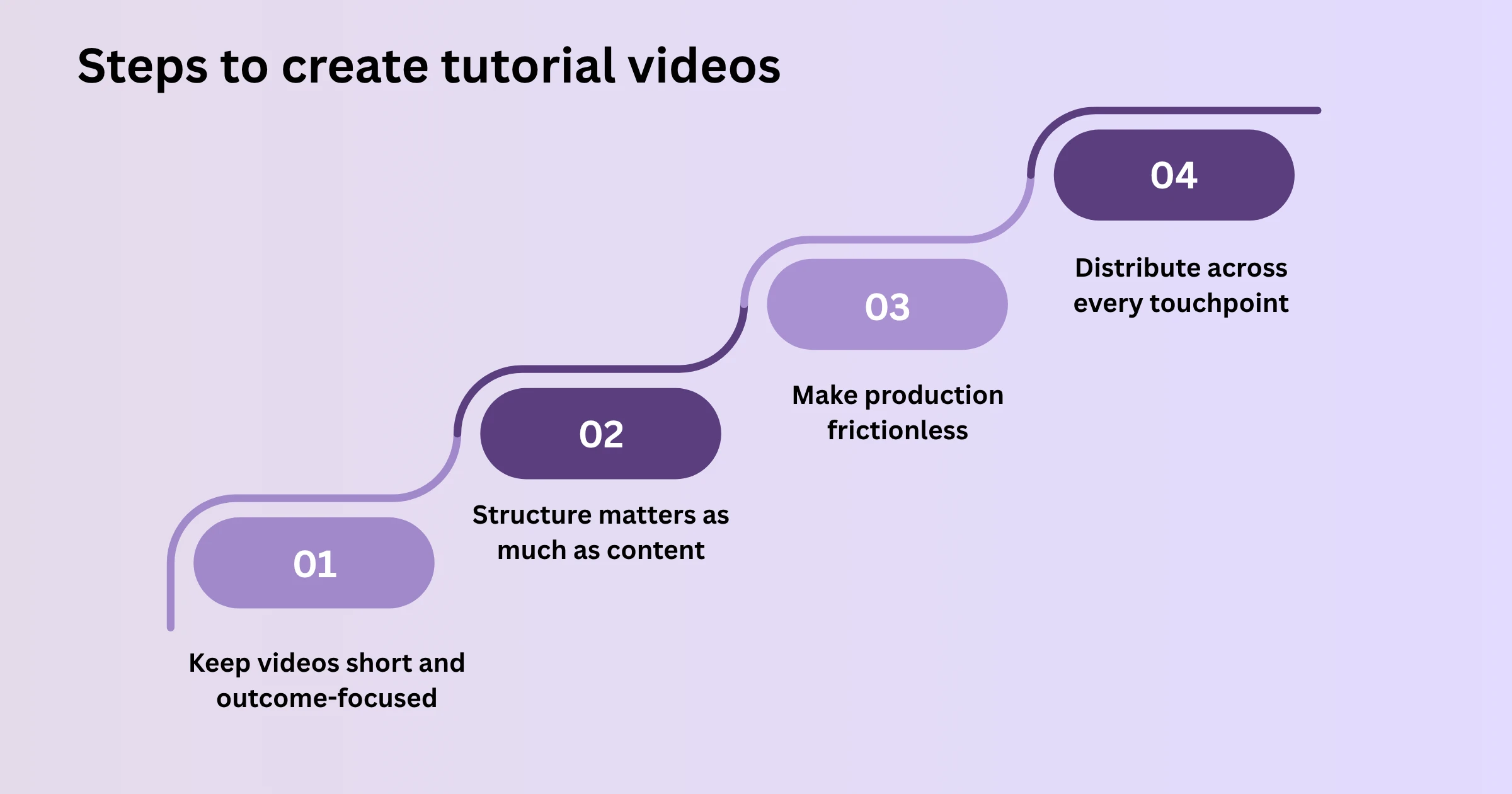
Keep videos short and outcome-focused
The most effective SaaS tutorial videos are between two and eight minutes long, depending on the complexity of the task being demonstrated. The key is that every video should have a single, clearly defined outcome. "How to connect your first integration" converts better than "a tour of the integrations dashboard." Users engage with content that promises them a specific result and delivers it efficiently.
Structure matters as much as content
A tutorial video that converts follows a consistent structure: state the outcome in the first 15 seconds, walk through the steps in real product screens, and end with a clear next action. WowTo's step-by-step format is designed around this pattern — each video frame corresponds to a discrete action in the product, making it easy for viewers to follow along without pausing to catch up.
Make production frictionless so you publish consistently
The biggest barrier to a video library is not quality — it is volume. Teams that rely on manual screen recording and post-production editing publish two or three videos and stop because the effort is too high. WowTo removes that barrier. Your team records a workflow using the Chrome extension, and WowTo handles the voiceover, formatting, annotations, and export automatically. How customer success teams create instructional videos without designers breaks down exactly how this works in practice.
Distribute across every touchpoint
Once created, a tutorial video should appear in more than one place. Embed it in your help center, include it in onboarding emails, add it to feature pages, and link to it in support responses.
Measuring the impact of tutorial videos on demos and retention
Switching from live demos to tutorial videos only makes sense if you can demonstrate the business outcome. The good news is that this is measurable.
What to track
The metrics that matter most when evaluating a video-first demo strategy are demo-to-trial conversion rate, time-to-first-value activation, inbound support ticket volume, and video engagement rate (watch time, drop-off point, and repeat views). If your async demo video is converting at a rate comparable to your live demo call, you have validated the model. If your support ticket volume drops after deploying a tutorial video library, you have demonstrated direct ROI.
Use drop-off data to improve the videos themselves
Most video platforms, including WowTo's knowledge base, give you watch time analytics at the video level. A tutorial video where 70% of viewers drop off at the two-minute mark is telling you something specific: either the pacing slows down, the step becomes confusing, or the framing was wrong. This feedback loop is impossible to get from a live demo call — it is one of the structural advantages of the async format.
Conclusion
For the vast majority of SaaS interactions — intro demos, onboarding walkthroughs, feature explanations, support responses — a well-made tutorial video does the job better, faster, and at a fraction of the cost. WowTo gives startups the infrastructure to build that system without a production budget or dedicated video team. If your team is still running the same demo call on repeat, record it once and let it work for you around the clock.
