What's the real ROI of how-to videos? A WowTo guide for SaaS & support teams
Most SaaS teams invest in how-to videos and assume the work is done. But the harder question — the one that actually matters to stakeholders — is: what is the return? According to Wyzowl, 87% of marketers say video has directly increased sales, yet most support and customer success teams still struggle to tie their how-to videos to measurable business outcomes.
The gap isn't in the content. It's in how teams think about video ROI. When a how-to video deflects a support ticket, retains a customer, or speeds up onboarding, each of those outcomes has a dollar value. This blog breaks down exactly how to calculate video marketing ROI for your how-to video library, what metrics actually matter for SaaS and support teams, and how to build a video knowledge base that compounds in value over time.
Why video ROI is different for support teams
Video marketing ROI is often discussed in the context of ad campaigns and content reach. For support teams, the calculation looks entirely different. Your how-to videos aren't chasing views — they're solving problems. Solved problems translate directly into cost savings, retained revenue, and reduced workload.
There are three places where video ROI shows up for support teams:
- Ticket deflection: Every question a customer answers by watching a video is a ticket your team doesn't handle.
- Churn reduction: customers who understand your product through clear video onboarding are less likely to cancel.
- Agent efficiency: When support staff spend less time on repeat questions, they handle more complex issues, which is a better use of their expertise.
Each of these outcomes is quantifiable. The challenge is building a system to track them, which starts with understanding which videos are actually working.
If you're building out a multilingual video library as part of your support strategy, multilingual support videos: how to reach global audiences with AI voices covers how to extend your video ROI across markets without a localization budget.
How do you calculate ROI on your videos?
The formula for video ROI is straightforward, but the inputs require intentional tracking. Here is the framework support teams should use:
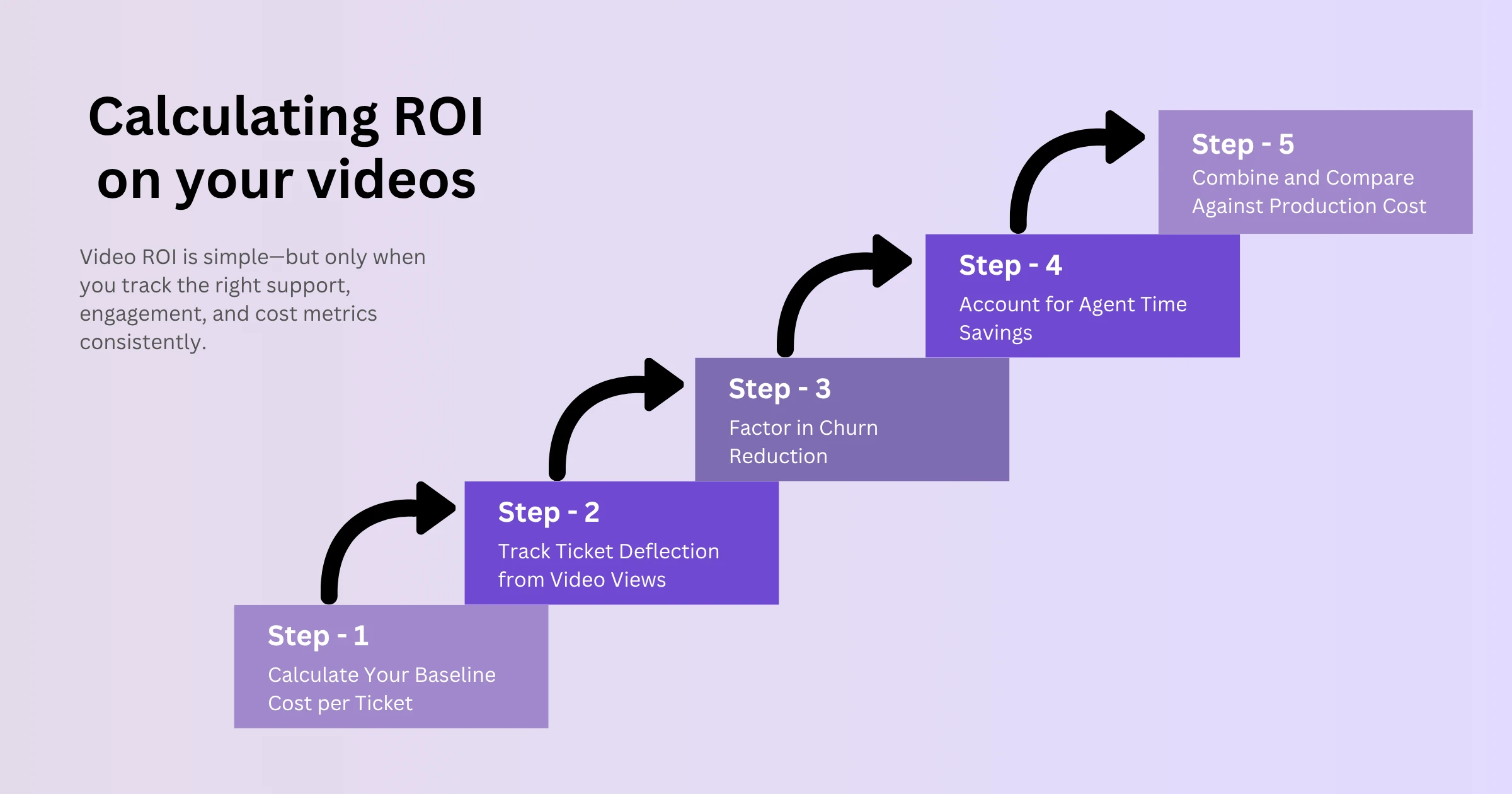
Step 1: Calculate your baseline cost per ticket
Start by calculating the average cost your team incurs per support ticket. Factor in agent salaries, benefits, tooling costs, and the average time spent per ticket. A typical SaaS company spends between $8 and $25 to resolve a single support ticket when agent time and overhead are factored in.
Step 2: Track ticket deflection from video views
Use your video analytics to identify how many users watched a how-to video and did not submit a ticket within 48 hours of viewing it. This gives you a rough deflection rate. Multiply deflected tickets by your cost per ticket to calculate monthly savings.
Formula: (Deflected tickets per month) x (Cost per ticket) = Monthly ticket deflection savings
Step 3: Factor in churn reduction
Compare churn rates for customers who engaged with your video knowledge base during onboarding versus those who did not. Customers who watch at least one how-to video during their first 30 days tend to have significantly higher retention rates. Calculate the revenue retained by applying the improvement in churn rate to your average customer lifetime value.
Step 4: Account for agent time savings
Track how many hours per week your support team spends on questions that a how-to video now answers. Multiply those hours by your fully loaded hourly cost per agent. This is your efficiency gain — and it compounds as your video library grows.
Step 5: Combine and compare against production cost
Add ticket deflection savings, retained revenue from reduced churn, and agent time savings. Compare that total to the cost of producing and maintaining your how-to video library. The result is your video ROI expressed as a percentage.
If you want a practical look at how video tutorials directly reduce ticket volume before calculating ROI, how to reduce customer support tickets with video tutorials walks through the mechanics in detail.
What a strong video knowledge base actually looks like
The difference between a video library that produces measurable ROI and one that doesn't usually comes down to structure. A collection of disconnected recordings hosted on a separate channel is not a video knowledge base. A video knowledge base is a searchable, organized, embeddable system that puts the right video in front of the right user at the right moment.
Here's what makes the difference:
- Searchability: customers should be able to find answers by searching — not by scrolling through a playlist.
- In-app embedding: the highest-performing support videos are surfaced inside the product using an in-app video widget, not linked from a separate help site.
- Organized by workflow: group videos by feature or task, not by the order in which they were created.
- Analytics per video: you can't improve ROI without knowing which videos are watched, replayed, or abandoned early.
For SaaS teams scaling their customer success function, how customer success teams can use video guides shows how video fits into a proactive retention strategy — not just reactive support.
The compounding effect of how-to videos
One of the most underappreciated aspects of video ROI is that well-made how-to videos compound in value over time. A text-based support article requires constant updating and still gets ignored by a large portion of customers. A clear, well-structured how-to video gets found, watched, and shared repeatedly — often long after it was produced.
Consider what happens when a SaaS team creates 20 focused how-to videos covering their most common support topics:
- Month one: videos go live and begin deflecting tickets from customers actively onboarding.
- Month three: the videos begin surfacing in search results, bringing in organic traffic from users who haven't yet signed up.
- Month six: support agents start linking to videos in their responses, reducing the time spent on each ticket they do handle.
- Month twelve: the video knowledge base has become a core part of onboarding, and churn rates in the first 90 days have dropped measurably.
The production cost stays roughly the same, but the return keeps growing. That's what makes video one of the highest-ROI investments a support team can make — when it's treated as a system, not a one-off project.
If your team is considering how to scale this without rebuilding from scratch, how to scale your video knowledge base as your product grows without rebuilding it is a practical guide to growing your library as the product evolves.
Where SaaS teams lose video ROI — and how to recover it
Even teams that invest seriously in how-to videos often undermine their own ROI in predictable ways. Here are the most common failure points and how to address them:
Videos that are too long
A ten-minute video covering five features is harder to watch, harder to search, and harder to update than five two-minute videos covering one feature each. Scoped videos consistently outperform general overviews when it comes to ticket deflection because customers are looking for a specific answer, not a tour. The how-to video creator approach — one workflow, one video — is the format that consistently drives the best deflection results.
Videos not embedded where customers actually are
Hosting videos exclusively on a separate help site means customers have to leave your product to find them. An in-app video widget — surfacing the right video inside the interface where users are already working — dramatically increases view rates and reduces the time-to-resolution.
No update process tied to the product release cycle
An outdated how-to video is worse than no video at all because it erodes customer trust. When a customer follows instructions in a video and the UI doesn't match, they submit a ticket anyway — and they're more frustrated than before they watched it. Tie video updates to your product release checklist so outdated content never goes live unaddressed.
No analytics to understand what's working
You can't improve what you don't measure. Tracking completion rates, drop-off points, and which videos lead to fewer follow-up tickets gives you the data to iterate intelligently. How to measure customer understanding using video analytics covers the specific metrics worth tracking to evaluate whether your videos are actually landing.
How does WowTo fit into a video ROI strategy?
WowTo is built for teams that need to prove the value of their video investment, not just publish content and hope for the best. The platform's video analytics track exactly what matters for ROI measurement — visitor trends over time, views per video, top countries, and browser language data — so you can see precisely which videos are driving engagement and where drop-off happens.
For support and SaaS teams trying to make the case for video investment internally, that combination of creation and measurement in one place is what makes the ROI conversation straightforward.
Video ROI beyond support: training and onboarding
How-to video ROI doesn't stop at the support queue. For SaaS teams, the same videos that reduce support tickets often serve double duty in customer onboarding and employee training — and the ROI calculation applies in both contexts.
A new customer who watches a focused onboarding video series during their first week reaches value faster. Faster time-to-value directly correlates with lower early churn. A new employee who goes through video-based training reaches productivity faster and requires less time from senior team members during ramp-up.
How to reduce time-to-value (TTV) using video tutorials breaks down how focused how-to videos move customers through the onboarding curve faster — which is a direct input to retention and expansion revenue. For teams managing employee onboarding at scale, how to reduce employee onboarding time with automated video training demonstrates how video-based training reduces ramp time and frees up manager capacity — both of which show up clearly in the ROI calculation.
Conclusion
Video ROI for SaaS and support teams isn't abstract. It shows up in fewer support tickets, lower churn, faster onboarding, and more efficient agents. The teams that get the most out of their how-to video investment aren't those with the biggest production budgets — they're the ones who treat video as a system, track the right metrics, and build a knowledge base that compounds in value over time.
The formula is straightforward: know your cost per ticket, track your deflection rate, connect video views to churn data, and build from there. Every video in a well-structured video knowledge base is working for your team around the clock — answering questions, onboarding customers, and reducing the load on your support agents without adding headcount.
Ready to build a how-to video library that actually moves your support metrics? Sign up on WowTo for free and start creating how-to videos today.
