How Do Microlearning Videos Improve Knowledge Retention?

Workplace training has a retention problem. Research from the Ebbinghaus Forgetting Curve shows that employees forget up to 70% of new information within 24 hours of a training session — and nearly 90% within a week, when nothing reinforces what was taught. For organizations investing in employee development, this is a costly gap. The format of training matters just as much as the content itself, and that is where microlearning videos are changing the equation.
Microlearning videos deliver focused, bite-sized learning content — typically between two and five minutes — that targets a single concept or skill at a time. Unlike multi-hour classroom sessions or dense e-learning modules, these short training videos fit naturally into an employee's workflow, making learning easier to absorb, revisit, and retain. As organizations look for effective training methods that actually stick, microlearning in employee training has become one of the most practical approaches available.
This blog breaks down exactly how microlearning videos improve knowledge retention, what makes them work from a cognitive standpoint, and how to build a microlearning strategy that drives measurable results in employee learning and development.
What is microlearning and why does it work?
Microlearning is a training approach that breaks down complex topics into short, focused learning units. Each piece of microlearning content addresses one objective — a process step, a policy update, a product feature, or a soft skill — without overwhelming the learner with information they are not ready to use.
The reason microlearning works is rooted in how the brain processes and stores information. Human working memory has a limited capacity, which means that when learners are exposed to too much content at once, much of it does not make it into long-term memory. Microlearning respects that limit by presenting only what is necessary for immediate understanding, reducing cognitive overload and improving the odds that the information is encoded properly.
Short training videos take this one step further by combining visual and auditory input simultaneously. This dual-channel approach — seeing and hearing information at the same time — activates more of the brain's processing pathways, which strengthens memory formation. It is why video-based learning consistently outperforms text-only instruction for long-term recall.
How microlearning videos improve knowledge retention
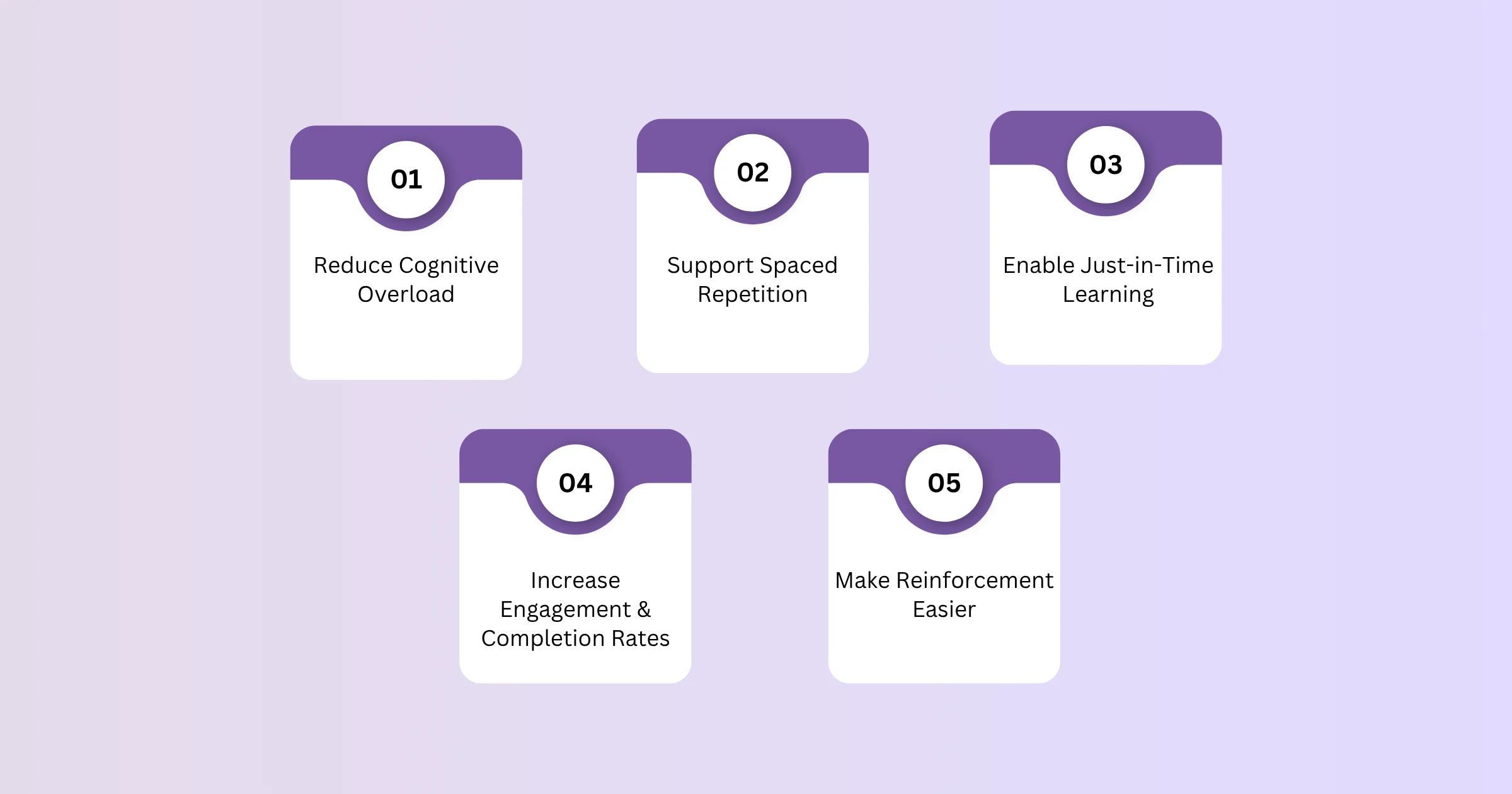
They reduce cognitive overload
One of the biggest barriers to learning retention in traditional training is information overload. When employees sit through hour-long sessions covering ten different topics, the brain struggles to prioritize what to remember. Microlearning videos sidestep this problem entirely. A two-minute video on how to handle a specific customer objection, for instance, gives the learner one clear takeaway — and that focused delivery dramatically increases recall.
They support spaced repetition
Spaced repetition is one of the most proven techniques in learning science. It involves revisiting material at increasing intervals to move it from short-term to long-term memory. Microlearning is uniquely suited to this approach because the short format makes it easy to re-watch or review a single concept quickly. Employees who revisit a three-minute microlearning video on compliance protocol a few days after the initial viewing are far more likely to retain it than those who attended a single two-hour compliance session months ago.
They enable just-in-time learning
One of the most powerful microlearning benefits is the ability to support just-in-time learning — delivering the right information at the moment an employee actually needs it. Rather than completing a course weeks before a task and then forgetting most of it, employees can pull up a relevant microlearning video right before they need to apply the skill. This context-to-application gap is one of the primary reasons traditional training fails to transfer into on-the-job performance.
They increase engagement and completion rates
Traditional long-form training often suffers from low completion rates and passive engagement. Employees zone out, skip sections, or abandon a course entirely when it feels too long. Microlearning videos hold attention more effectively because the learner knows the content will be brief, focused, and useful. That mental commitment to a two-minute investment is far lower than committing to a forty-minute module, and higher completion rates naturally lead to better employee knowledge retention.
They make reinforcement easy
Reinforcing what employees have learned is just as important as the initial training. With microlearning, reinforcement becomes practical. A manager can share a one-topic video in a team chat before a product launch. HR can send a refresher clip before a quarterly compliance deadline. This kind of lightweight, scalable reinforcement — delivered through bite-sized learning — keeps knowledge active without requiring employees to redo an entire training program.
Microlearning vs traditional training for knowledge retention
Traditional training tends to prioritize coverage — fitting as much content as possible into a single session. Microlearning prioritizes depth — ensuring that what is taught is actually remembered and used. The contrast matters because organizations often measure training success by completion, not by whether employees actually retained and applied what they learned.
In a side-by-side comparison of microlearning and long-form training videos, the two formats serve different purposes. Long-form content still has value for foundational onboarding or certifications where depth is required. But for ongoing skill development, process updates, and performance support, microlearning consistently yields higher learning retention because it aligns with how memory actually works.
That said, microlearning is not a replacement for all training — it is a complement. The most effective employee training programs use both formats strategically, relying on upskilling and reskilling through video training to ensure employees can grow with the organization over time.
Best microlearning strategies for employee training
Keep each video to a single learning objective
The most common mistake in microlearning content creation is trying to cover too much in one video. Each microlearning video for training should answer one question, demonstrate one skill, or explain one concept. If the topic requires more, break it into a series. This structure keeps videos concise, searchable, and reusable as reference material.
Design for replay, not just initial viewing
Effective microlearning videos work as on-demand resources, not just one-time training events. Design the content so employees can return to it quickly when they need a refresher. Clear titles, logical organization, and consistent formatting across your library make it easier for employees to find the specific video they need, exactly when they need it.
Embed learning moments in the workflow
The most impactful microlearning strategy is integration. Rather than asking employees to leave their work context to complete training, embed microlearning videos directly into the tools and platforms they already use. A short onboarding video that appears inside a software dashboard, or a quick how-to clip linked from a help doc, turns training into a natural part of the workday rather than an interruption.
Use visuals and narration together
The dual-coding effect — processing visual and verbal information at the same time — is one of the strongest levers for improving knowledge retention. Microlearning videos that combine screen recordings, graphics, or animated visuals with clear narration are significantly more effective than text-heavy slides or silent screen captures. For teams looking to understand the impact, why AI-voiced videos outperform silent screen recordings for comprehension explains this dynamic in detail.
Track engagement to identify gaps
A microlearning strategy without measurement is guesswork. Use video analytics to understand which videos employees re-watch, where they drop off, and which topics generate the most searches. These signals tell you where retention is weakest and where your microlearning content library needs strengthening. Teams looking to build this kind of feedback loop can explore how to measure customer understanding using video analytics for a practical framework.
How to create effective microlearning videos
Creating effective microlearning videos does not require a production studio or a large budget. The key is clarity of purpose before production. Start by identifying the specific knowledge gap the video needs to address. Define the single outcome you want the viewer to walk away with. Then build the video around that outcome — nothing more, nothing less.
For teams managing employee training videos at scale, converting existing SOPs and process documents into short video formats is one of the most efficient starting points. The content already exists — the work is in translating it into a visual, narrated format that employees can actually absorb.
Consistency matters across a microlearning library. Videos that follow the same structure, tone, and visual style feel like a cohesive system rather than a collection of one-off clips. This consistency also helps employees navigate the library faster, because they know what to expect from each video format.
How WowTo supports microlearning video creation
Building a microlearning video library from scratch can feel like a heavy lift — especially for teams without dedicated video production resources. WowTo is an AI-powered video creation platform designed specifically for this kind of training and support content. It lets teams create professional, narrated how-to and training videos directly from screen recordings, slide decks, or text-based SOPs — without needing video editing expertise.
With built-in AI voiceover, avatar support, and multilingual capabilities, WowTo makes it practical to build and maintain a scalable microlearning video library that actually keeps employee knowledge retention high. For organizations looking to connect their video content to a broader knowledge system, WowTo integrates naturally with a video-based internal knowledge base — making microlearning content easier to organize, search, and update as the organization evolves.
Conclusion
Microlearning videos work because they align with how the brain actually learns. By delivering focused, bite-sized content at the right moment, supporting spaced repetition, and making reinforcement scalable, microlearning in employee training addresses the core reasons traditional training fails to produce lasting knowledge retention.
The shift from long-form training to a microlearning strategy is not about doing less — it is about doing training smarter. When employees can access a two-minute video that answers exactly what they need right when they need it, learning becomes part of the work rather than a separate event they are asked to attend and then forget.
For organizations serious about improving employee knowledge retention, the path forward starts with building a microlearning content library that is focused, well-organized, and easy to update. The tools to do that are more accessible than ever.
Ready to build microlearning videos your employees will actually remember? Start for free with WowTo and create your first training video in minutes.
